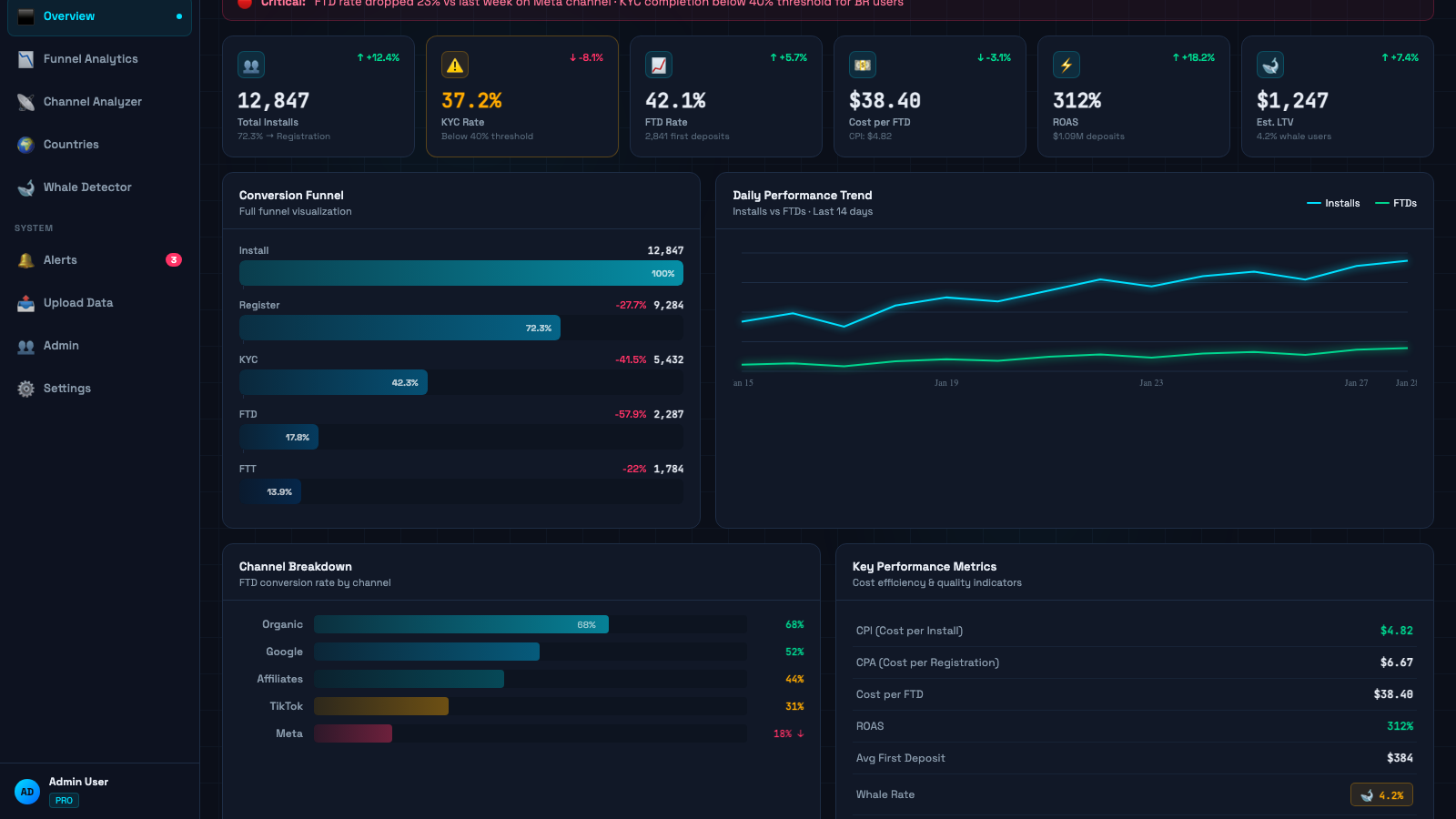
Crypto User Acquisition Funnel Optimization: The Complete Guide to Lower CAC and Increase First-Time Deposits
Crypto growth is rarely limited by reach. It is limited by conversion quality.
Get Your Free Crypto Funnel Audit
Upload your CSV and instantly see where users drop off from install to first deposit — free.
Crypto User Acquisition Funnel Optimization: The Complete Guide to Lower CAC and Increase First-Time Deposits
Crypto growth is rarely limited by reach. It is limited by conversion quality.
Teams can buy clicks, installs, and registrations every day, but profitable growth only happens when users move through the full path from acquisition to activation and monetization. In crypto, that means understanding the stages between first touch and first-time deposit, then improving each one with the right analytics and operating rhythm.
This guide explains how to optimize your crypto user acquisition funnel, reduce wasted ad spend, improve KYC completion, and increase first-time deposits without relying on vanity metrics.
If you run a crypto exchange, wallet, trading app, or Web3 finance product, this is the framework that turns traffic into revenue.
What Is a Crypto User Acquisition Funnel?
A crypto user acquisition funnel is the sequence of stages a user moves through after discovering your product. Most teams track top-of-funnel performance, but the strongest operators measure the full commercial journey:
- Install or visit
- Registration
- KYC started
- KYC completed
- First-time deposit (FTD)
- First trade or first transaction
- Retention and repeat activity
This matters because crypto products have more friction than traditional consumer apps. Users often have to verify identity, connect payment methods, understand deposit flows, and trust the platform before completing a meaningful action.
If you only optimize for clicks or installs, you will scale volume without understanding quality.
Why Crypto Funnel Analytics Matter More Than Generic Marketing Dashboards
Generic performance dashboards usually stop at cost per click, installs, or registrations. That leaves a dangerous blind spot.
In crypto, the real business outcome happens later in the funnel. A campaign with cheap installs may still be unprofitable if users fail KYC or never make a deposit. A more expensive campaign can be the better growth bet if it delivers stronger first-time deposit rates and healthier retained cohorts.
That is why crypto funnel analytics should answer questions like:
- Which channels produce the highest first-time deposit rate?
- Where does KYC drop-off happen by country or platform?
- Which paid campaigns bring high-value cohorts instead of low-intent traffic?
- How fast do acquired users move from install to first deposit?
- Which geographies produce whales, repeat depositors, or stronger retention?
The teams that win are not the ones buying the cheapest traffic. They are the ones measuring full-funnel conversion quality.
The Core Funnel Metrics Every Crypto Team Should Track
To optimize a crypto acquisition funnel, you need a shared measurement model across growth, product, analytics, and operations.
The most important metrics include:
- Install-to-registration rate
- Registration-to-KYC start rate
- KYC completion rate
- KYC approval rate
- First-time deposit rate
- Cost per KYC-approved user
- Cost per FTD
- Average first deposit amount
- D7 and D30 retention
- LTV by channel, geo, and cohort
These metrics reveal whether you have a targeting problem, an onboarding problem, a compliance bottleneck, or a monetization issue.
For example:
- Low install-to-registration rate often points to weak landing page alignment or poor audience intent.
- Low KYC start rate usually signals trust or onboarding friction.
- Low KYC approval rate often points to document quality, vendor rules, or geo-specific issues.
- Low FTD rate after KYC suggests deposit UX or payment method friction.
Without stage-level measurement, teams tend to solve the wrong problem.
The Biggest Funnel Leaks in Crypto User Acquisition
1. Low-intent traffic from paid campaigns
Many crypto brands scale channels that look efficient at the top of the funnel but attract users with weak commercial intent. This often happens when creative messaging is too broad, incentive-led, or disconnected from the actual product experience.
The result is predictable: registrations go up, KYC quality weakens, first-time deposits lag, and CAC quietly increases.
2. KYC friction
KYC is one of the biggest revenue checkpoints in crypto. If users do not understand why verification matters, do not trust the flow, or encounter unclear errors, they abandon before reaching deposit.
KYC should be treated as a conversion stage, not a compliance afterthought.
3. Deposit flow complexity
Even when users complete KYC, many crypto products lose momentum at the deposit stage. Payment options may be unclear, fees may create hesitation, or the deposit path may feel too technical for new users.
4. Geo mismatch
A channel that performs well in one market can underperform badly in another. KYC rules, payment habits, document types, and trust signals all vary by country. If you only look at global averages, profitable segments get hidden by weak ones.
5. Slow feedback loops
Many teams review performance too late. By the time they realize FTD rate has dropped or CPI has increased against weak cohorts, budget has already been wasted. Good funnel operations require proactive alerting and weekly decision-making.
How to Improve Crypto User Acquisition Funnel Performance
Align traffic quality with downstream outcomes
Start by evaluating channels using full-funnel metrics instead of install volume alone. Compare paid social, search, affiliates, influencer traffic, and organic sources on:
- Cost per KYC-approved user
- Cost per first-time deposit
- Average first deposit amount
- D30 retention
- LTV/CAC ratio
This instantly shows which channels deserve scale and which are only creating noise.
Reduce KYC drop-off with better onboarding
KYC completion improves when users understand the value exchange and trust the process. Practical improvements include:
- Clear explanation of why verification is required
- Progress indicators in onboarding
- Better field guidance and error copy
- Country-specific document instructions
- Mobile-friendly image capture and retry states
- Faster review times where possible
Small KYC improvements can create large downstream gains because every recovered user becomes eligible for deposit and activation.
Make the first deposit path simpler
The transition from approved user to funded account should feel obvious and low-friction. Focus on:
- Strong post-KYC prompts to deposit
- Local payment method relevance
- Clear fee communication
- Trusted UI around fiat and crypto deposit options
- Educational prompts for first-time crypto users
If approved users do not deposit, the problem is usually not traffic. It is activation design.
Segment performance by country, platform, and campaign cohort
Crypto funnel optimization becomes much more powerful when you break performance down by:
- Country
- Platform
- Acquisition source
- Campaign or creative set
- Time cohort
This is how you find truths like:
- Meta works well in one geo but not another.
- Android has higher KYC friction than iOS.
- Search traffic has lower volume but stronger first-time deposit quality.
- Affiliates drive cheap registrations but weak retained value.
Segmentation is where budget decisions become strategic instead of reactive.
A Practical Crypto Funnel Optimization Workflow
The best teams run funnel optimization as an operating system, not an occasional analysis project.
A practical weekly rhythm looks like this:
- Review funnel stage conversion rates over the last 7 and 30 days.
- Compare channels on cost per KYC-approved user and cost per FTD.
- Identify the largest drop-off point in the funnel.
- Segment that drop-off by country, platform, and campaign.
- Launch one focused fix for the highest-impact bottleneck.
- Set alerts for sudden changes in KYC, FTD, CPI, or whale activity.
- Reallocate budget only after checking downstream cohort quality.
This process prevents teams from overreacting to noisy top-of-funnel signals.
SEO and Content Strategy for Crypto Growth Teams
If you want to attract high-intent traffic organically, your content strategy should mirror the same funnel logic used in paid acquisition.
Strong SEO content in this niche usually targets search intent around:
- Crypto marketing analytics
- Crypto funnel analytics
- KYC conversion optimization
- Crypto CAC reduction
- First-time deposit optimization
- Crypto exchange growth strategy
- Web3 onboarding analytics
The goal is not to generate traffic for broad keywords alone. It is to earn qualified visits from operators actively searching for solutions to funnel performance problems.
That means every article should include:
- A clear primary keyword
- Related secondary keywords
- Practical frameworks and real use cases
- Internal links to product and supporting content
- Helpful metadata, headings, and structured summaries
This article itself is an example of SEO content designed around commercial search intent in the crypto analytics niche.
How Crypto Funnel Analyzer Helps
Crypto Funnel Analyzer is built for teams that need to connect acquisition, activation, and monetization in one view.
Instead of stitching together ad dashboards, spreadsheet exports, and post-KYC reports, teams can use one platform to:
- Measure full-funnel conversion from install to retention
- Compare channels by CPI, FTD rate, ROAS, and estimated LTV
- Break down performance by country and platform
- Detect whales and high-value cohorts
- Trigger alerts when KYC or FTD performance drops
That creates a faster feedback loop for budget allocation, onboarding improvements, and revenue-focused decision-making.
Common Mistakes to Avoid
When teams try to optimize crypto user acquisition, they often make a few recurring mistakes:
- Judging channels on installs or registrations instead of deposits
- Treating KYC as a compliance-only metric
- Ignoring country-level variation
- Scaling budget before fixing activation bottlenecks
- Looking at short-term ROAS without retention context
- Measuring too many stages loosely instead of a few stages consistently
Avoiding these mistakes can be more valuable than any single growth hack.
Final Takeaway
Crypto user acquisition funnel optimization is not about generating more top-of-funnel traffic. It is about improving conversion quality from first touch to first-time deposit and beyond.
The strongest crypto teams use full-funnel analytics to understand where users drop off, which channels bring valuable cohorts, and which fixes will create the largest revenue lift. When you connect acquisition cost to KYC performance, deposit behavior, and retention, growth decisions become clearer and more profitable.
If your team wants lower CAC, better KYC completion, and higher first-time deposits, start by measuring the full funnel and optimizing the stage where revenue is leaking most.
CryptoFunnel Team
Crypto Analytics Experts
We help crypto and Web3 companies optimize their user acquisition funnels — from install to first deposit. Our analytics platform is trusted by 500+ teams worldwide.
Verified Data
Real campaign metrics
500+ Teams
Trust our platform
Always Current
Regularly updated